In the middle of modern-day Turkey lies a unique lunar landscape of caves, tunnels, and hundreds of entire underground cities that span for miles, which were first carved out by the pagan Hittites over 3,000 years ago. Called Cappadocia, this land of lost cities has secrets inside every cave and around every corner — from honeycombs of tunnels rigged with booby-traps to the clandestine routes of fierce battle.
 Also known as Capadocia or Kapadokya, the secret pagan underworld hidden beneath its bizarre terrain has been a battlefield for invading empires, enduring bloody wars and religious battles that had threatened to destroy them. Signs of the ancient evolution of warfare and traces of a mystifying pagan empire have been buried for thousands of years.

City in Cappodocia.

Rock hewn houses and churches in Goreme, Cappadocia. Photo Alaskan Dude

The first monasteries in the world were built here, with over 200 churches constructed in the area, and the remains of an advanced civilization that mysteriously disappeared.
Cappadocia is 200 miles south of Ankara, the capital of the modern Republic of Turkey, sitting in the center of the high dessert of central Anatolia. This region has always held mystery — from supposed magnetic fields with healing powers that locals swear by, to UFO sightings going back thousands of years.


Peeling back the layers of time on these cities of the underworld, this region is unlike any other on earth. Just how did ancient cultures dig these massive structures out of solid rock?
Millions of years ago, volcanic eruptions created this totally unique lunar landscape on earth. Over time, the 3 major volcanoes in the region spewed thousands of tons of volcanic materials across the land.
The first eruptions left a layer of soft rock called tufa, and subsequent eruptions left a much harder layer of basalt. This dense material created a protective surface that slowed the erosion of the underlying tufa. Eventually rain, wind, and blowing sand began to erode it, creating these huge plateaus, valleys, gorges, and fairy chimney rock formations that span for miles.


For thousands of years people have been digging in the soft volcanic rock, creating a vast mega metropolis below ground. There are over 100 square miles filled with heavily fortified castles, secret churches, dungeons, and entire underground cities built to defend the locals against the armies of history’s most powerful empires.
For generations, villagers have guarded the secrets of Cappadocia’s underworld, but as the modern world rallies with the ancient one, their dark secrets are becoming revealed.

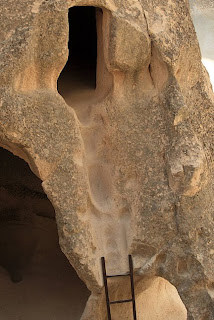
Ladder to a rock house in Cappadocia.

Fairy chimneys. This area is part of a UNESCO World Heritage site.


Its unique landscape makes it a popular tourist destination, but the terrain conceals a hidden world. Hundreds of underground cities and massive fortresses dug into the mountains connect to create one of the most massive of terrainian networks in the world. Here, civilizations fought their bloody last stands and secret religions were spawned.

3,500 years ago, this towering 197 foot (60 meter) high rock column was one of the 3 major citadels for the pagan tribes that lived here. These rock fortresses were the key to survival at a time when tribal warfare could wipe out entire villages.
Cappadocia’s long and bloody history gives us a clue as to why the locals carved out these cities below, rather than living above. It was a highly coveted and dangerous region that sat in the center of the major trade routes which connected the world’s great empires from China, India and Egypt in the east, to Greece and Rome in the west. Whoever controlled Cappadocia controlled the trade routes and was guaranteed a share of the riches carried along it.
The Romans, Persians and Mongols fought bloody battles to control it. Coupled with tribal warfare, it was a dangerous place to call home. The local pagan population found themselves drastically outnumbered and outgunned. To defend themselves, they created another world below ground.

Fairy chimneys in Cappadocia with volcano in the distance. Photo Alaskan Dude


Rock formation in Cappadocia known as the Camel.


City full of rock houses in Cappadocia, Turkey.
The soft tufa rock left behind by the volcanic ash that blanketed the region 10 million years before was easy to carve, and the hard basalt layer on top provided protection. The Cappadocians began with simple rock shelters that developed into vast labyrinths of underground cities and fortresses. Some of these cities could support as many as 20,000 people, and did so for 25 centuries, up until the 1300’s.


Ancient rock houses intermingled with modern houses in Cappadocia, Turkey.
When the region stabilized in the 14th century, villages began to thrive above ground, and some of the ancient cities were sealed up, and forgotten. In the 1960’s, locals started to explore the closed off tunnels. They had heard rumors of their ancestor’s subterranean existence, but no one could imagine how vast they were.
Over 200 cities have been found intact beneath Cappadocia. Experts believe there are many more waiting to be discovered.


The Hittites were one of the most advanced empires of the ancient world, reigning from 1700 BC to 1190 BC, and thought to be the first Cappadocians to live underground. Their ancient writings refer to troubles from invaders they called the ‘Sea People.” The Hittites appeared to have flourished in the region for over 500 years, but in the 12th century BC, they mysteriously vanished. The underground of Cappadocia was their last refuge.
Cappadocians became more advanced in underground living as the threats from up above forced them deeper into the ground. As rival tribes of the mysterious Sea People approached, villages abandoned their lives above and prepared to wait it out down below in lethal military forts.

Passageway in the underground city of Kaymakli, Cappodocia, Turkey.
Millstones weighing up to a ton were rolled in front of the entrances to shut off access into parts of the city. Inside the rooms, just a few men could easily roll one of these millstones into place, but from the other side, even an army couldn’t budge it.


Millstone to shut off entrance.
The massive hand carved cavities left behind became increasingly useful in the 1st century AD when another persecuted group, the Christians arrived. This new religion was able to take root and flourish underground in Ozkunak, a small village in the northeast region of Cappadocia. Because Ozkunak was the 3rd largest city in Cappadocia, the local government installed a secure entrance to prevent treasure hunters from stealing any precious artifacts.

Secured entrance into Ozkunak.

Underground Ozkunak, 1st floor used as a stable.
Ozkunak was a multi-leveled city — animals occupied the first level, and the villagers took cover on the 2nd level, 20 feet (6 meters) beneath the ground. Over 3,000 people could live in this massive complex for months at a time.
Escaping persecution from Roman solders in these networks, the Christians faced the last and most antagonistic aggression against them in 303 AD. Thousands were hunted and killed. Muslim Arab armies continued the persecution, but when they arrived in the villages above, they found ghost towns, as the Christians fled to safety below.
The Roman soldiers soon realized the villagers were beneath their feet, and the real battle began — but the Christians were ready. The narrow tunnels slowed the enemy to a crawl, and for those determined enough to go on, there were more surprises of booby-traps — holes in the ceilings to spear the enemy in the head. More defensive traps of millstones were used to trap the enemy in large rooms until they died. In a third defensive system, holes were carved in ceilings to pour hot oil on their enemies.


Ozkunak was the only underground city that devised a telecommunication system. The large chambers built to reverberate sound waves provided an echo, and holes carved in walls could carry sound to other rooms and floors. A person above could hear instructions given from below even when spoken at a whisper.
In the 4th century, Emperor Constantine made Christianity the official religion of the Roman Empire. After centuries of hiding out in these subterranean cities, Christians could finally come out of the underworld.
Even though they were finally free to practice out in the open, they chose to stay underground, expanding on the underground cities, and creating a Christian stronghold away from the eyes of the world in Goreme. The evolution of the religion is hidden inside these caves of Cappadocia.


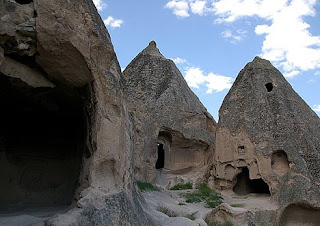
This valley hides hundreds of churches — from crude caves to intricate basilicas that rival the great Cathedrals of Rome. These caves were used to create the first monastery of the official religion of the largest empire of the world. Monks ate, slept, and prayed in seclusion, living here until the 14th century, which had been the basis of monastic life as we know it today.
Goreme became a monastic center between 300 to1200 AD. In the middle ages, it was very rare to find people who could read, and the churches were normally used to teach Christianity to illiterate people. Ancient frescoes within the churches preserve the stories of the world’s first monasteries. The intricate frescoes were used like a text book, telling stories of the bible and the life of Jesus from his birth to crucifixion in pictures.
 Selime Cathedral.
 This artwork in one of the rock hewn churches is over 1,000 years old.
 Facade for the Dark Church, Goreme, Cappadocia, Turkey.
 In the Snake Church, Goreme, Cappadocia, Turkey.
The Snake Church takes its name from the serpent that represents the dragon St. George is shown slaying in a painting on the left wall, and a striking fresco of Constantine the Great and his mother Helena, both wearing haloes of sainthood, holding the True Cross.
An extensive kitchen and refectory complex connects the Snake Church with the Dark Church. The facade of the Dark Church fell away in a rock slide, exposing a long row of arches, each decorated with a cross.

Fresco in the 10th Century Buckle Church in Goreme, Cappadocia.

Frescoes from the 10th century inside the Tokali Kilise (Buckle Church), Goreme.

Frescos and archways in the Buckle Church, Goreme, Turkey.

Underground chamber in the Buckle Church, Goreme, Cappadocia.
 A rock-hewn temple in Cappadocia.
The eastern Roman Empire was left weak and vulnerable by the 4th Crusades in 1204. Muslim Turkish tribes had infiltrated the area and were constantly at war with each other and anyone in their path, and brutal Mongol invasions were always a threat. Gangs of thugs and thieves were also always on the lookout to steal expensive camels and their cargo.
Cappadocia remained part of the Ottoman Empire for the centuries to come, and continues to be part of the modern state of Turkey today. The massive underground cities were used as refuges as recently as 1839 by the Turkish population fleeing an invading Egyptian army.


 Agirnas is a town that sits above 5-level subterranean city that extends nearly 4 miles, first inhabited by the Romans in the 2nd century. As each new generation moved in, they expanded the city both above ground and below. The 1900-year-old architecture 23 feet (7 meters) beneath the ground inspired some of the greatest engineering feats on the planet.
The arches in lower levels of the home of one of the world’s most influential architects of the era, Mimar Sinan, were his inspiration for the triple arch system, which builds upon the simple Roman arch. The weight from above is distributed throughout the sides, with 3 arches sharing a simple axis, the load bearing capacity triples.

 These triple arches were used throughout the underworld. Nineteen centuries later, these 2nd century walls can still hold up the thousands of pounds bearing down on them from the modern town that continues to grow up above.
What also sets this city apart is a 3 1/2 mile subterranean factory, forging tools from iron, and a workshop bearing a pigeon house. Considered a precious commodity by ancient civilizations, bird droppings from the pigeons contain high nitrates, and the highly explosive substance was perfect for making gun powder. This was a massive subterranean weapons factory.


New cities are being continually discovered, but a recent find was no ordinary one — which may even re-write history. The dig may be the largest and most sophisticated in all of Turkey, and is still being excavated today. Located in the town of Gaziemir, experts believe this time capsule dates back 800 years to the dangerous days of the of the Silk Road which was the ancient trade route of the ancient world, and the lifeline for people to get from one place to another, transporting everything under the sun.
It extended 7,000 miles, which meant that stopping places were needed. This stopping post lost favor in the 14th century, and hundreds of years of debris buried it beneath the ground, but recently archeologists have exposed a major component to Cappadocia’s past.


Recent dig beneath Gaziemir.
This village stood strategically on the busy 7,000 mile Silk Road, and similar serai’s like this one were built between every 18 to 25 miles — the distance a camel could cover in a day’s travel.
Travelers from all over the world would have entered from a massive gate. Once inside there were stables for their animals, storage room for their goods, sleeping quarters, fountains, baths, wineries, a central room where food was served, and areas for doing business.

Depiction of a caravan serai.
Caravan serai’s like this one could cover 50,000 square feet (15,228 meters), and without them, long distance travel would have been virtually impossible.
In the 13th century, this entire region was unstable, and this ‘4-star hotel’ was in the middle of a warzone. Most of the local villagers took refuge in the underground cities, and travelers on the Silk Road needed security.
The tunnels were used as corridors, more than 10 feet (3 meters) tall to accommodate Asian camels. Travelers from all over the world — mostly rich merchants carrying their goods camel-back — would have stopped here for a rest after a long day of travel and trade, and tied up their camels in a large courtyard where they would unload their goods.


Courtyard at Gaziemir.
The archeological site of Gaziemir is the only one in Cappadocia to unearth camel bones. Just 3 months into this dig, archeologists have discovered unprecedented relics, but they’ve only uncovered a fraction of this caravan sarai.
Over 100 of these fine caravan sarai’s can still be seen in Turkey, many of them in Cappadocia.

Arches in an unknown building in Cappadocia, Turkey.

Stained glass window in a Turkish gem shop in Cappadocia, Turkey.

Tree full of Evil eyes.
Like ancient time capsules, these underground cities preserved Cappadocia’s dark and mysterious past. Today, like their ancestors, locals are moving back into these ancient caves, turning them into boutique hotels and luxury homes.
The Goreme Open Air Museum is the most visited site of the monastic communities in Cappadocia and is one of the most famous sites in central Turkey.

Part of the region of these exceptional natural wonders was designated a UNESCO World Heritage site in 1985, which carries the mystical side of history today.


 Facade for the Dark Church, Goreme, Cappadocia, Turkey.


