Friday, May 8, 2009

Some Miracles of The Quran

THE WELL-GUARDED SKY

In the Qur'an, Allah calls our attention to a very important attribute of the sky:
We made the sky a preserved and protected roof yet still they turn away from Our signs. (Qur'an, 21:32)

This attribute of the sky has been proved by scientific research carried out in the 20th century: The atmosphere surrounding the Earth serves crucial functions for the continuity of life. While destroying many meteors-big and small-as they approach the Earth, it prevents them from falling to Earth and harming living things.

In addition, the atmosphere filters the light rays coming from space that are harmful to living things. The most striking feature of this function of the atmosphere is that it lets only harmless and useful rays-visible light, near ultraviolet light and radio waves pass through. All of this radiation is vital for life. Near ultraviolet rays, which are only partially let in by the atmosphere, are very important for the photosynthesis of plants and for the survival of all living things. The majority of the intense ultraviolet rays emitted from the Sun are filtered out by the ozone layer of the atmosphere. Only a limited and essential part of the ultraviolet spectrum reaches the Earth.

The protective function of the atmosphere does not end here. The atmosphere also protects the Earth from the freezing cold of the space, which is approximately -2700C (-4540F).

It is not only the atmosphere that protects the Earth from harmful effects. In addition to the atmosphere, the Van Allen Belt-the layer caused by the magnetic field of the Earth-also serves as a shield against the harmful radiation that threatens our planet. This radiation, which is constantly emitted by the Sun and other stars, is deadly to living things. If the Van Allen belt did not exist, the massive outbursts of energy called solar flares that frequently occur in the Sun would destroy all life on Earth.

On the importance of the Van Allen Belt, Dr. Hugh Ross says:

In fact, the Earth has the highest density of any of the planets in our Solar System. This large nickel-iron core is responsible for our large magnetic field. This magnetic field produces the Van-Allen radiation shield, which protects the Earth from radiation bombardment. If this shield were not present, life would not be possible on the Earth. The only other rocky planet to have any magnetic field is Mercury-but its field strength is 100 times less than the Earth's. Even Venus, our sister planet, has no magnetic field. The Van-Allen radiation shield is a design unique to the Earth. ("The Incredible Design of the Earth and Our Solar System;")

The energy transmitted in just one of these bursts detected in recent years was calculated to be equivalent to 100 billion atomic bombs, each akin to one dropped on Hiroshima at the end of World War II. Fifty-eight hours after the burst, it was observed that the magnetic needles of compasses displayed unusual movement and 250 kilometers (155 miles) above the Earth's atmosphere, the temperature suddenly increased to 2,5000C (4,5320F).

In short, a perfect system is at work high above the Earth. It surrounds our world and protects it against external threats. Centuries ago, Allah informed us in the Qur'an of the world's atmosphere functioning as a protective shield.

THE SKY MADE A DOME

It is He Who made the Earth a couch for you, and the sky a dome. He sends down water from the sky and by it brings forth fruits for your provision. Do not, then, knowingly make others equal to Allah. (Qur'an, 2:22)

Here, the sky is described as "al-samaa' binaa'." As well as the meaning of "dome" or "ceiling," this also describes a kind of tent-like covering used by the Bedouin. ("The Quran and Modern Physics;") By describing the sky as a tent-like structure, the Qur'an is emphasizing that it is a form of protection against external elements.

Even if we are generally unaware of it, a large number of meteors fall to the Earth, as they do to the other planets. The reason why these make enormous craters on other planets but do no harm on Earth is that the atmosphere puts up considerable resistance to a falling meteor. The meteor is unable to withstand this for long and loses much of its mass from combustion due to friction. This danger, which might otherwise cause terrible disasters, is thus prevented thanks to the atmosphere. As well as the verses regarding the protective properties of the atmosphere cited above, attention is also drawn to the special creation in the following verse:

Don't you see that Allah has made everything on the Earth subservient to you and the ships running upon the sea by His command? He holds back the heaven, preventing it from falling to the Earth-except by His permission. Allah is All-Compassionate to humanity, Most Merciful. (Qur'an, 22:65)

The protective property of the atmosphere we discussed in the preceding section protects the Earth from space-in other words, from external elements. With the word "dome," referring to the sky in the above verse, attention is drawn to this aspect of the sky, which could not possibly have been known at the time of our Prophet (saas). The fact that this information was imparted 1,400 years ago in the Qur'an, when there were no spacecraft or giant telescopes, shows that the Qur'an is the revelation of our Lord, the Omniscient.

THE SKY THAT RETURNS

The verse 11 of Surat at-Tariq in the Qur'an, refers to the "returning" function of the sky.

[I swear] by heaven which returns. (Qur'an, 86:11)

The word "raj`" interpreted as "return" in Qur'an translations has meanings of "sending back" or "returning." As is known, the atmosphere surrounding the Earth consists of many layers. Each layer serves an important purpose for the benefit of life on Earth. Research has revealed that these layers have the function of turning the materials or rays they are exposed to back into space or back down to the Earth. Now let us examine, employing a few fitting examples, this "returning" function of the layers encircling the Earth.

The troposphere, 13 to 15 kilometers (8 to 9.3 miles) above the Earth, enables water vapour rising from the surface of the Earth to be condensed and turned back as rain. The ozone layer, the lower layer of stratosphere at an altitude of 25 kilometers (15.5 miles), reflects harmful radiation and ultraviolet light coming from space and turns both back into space.

The ionosphere reflects radio waves broadcast from the Earth back down to different parts of the world just like a passive communications satellite. Thus, it makes wireless communication, radio, and television broadcasting possible over long distances. The magnetosphere layer turns the harmful radioactive particles emitted by the Sun and other stars back into space before they reach the Earth.

The fact that this property of the atmosphere's layers, that was only demonstrated in the recent past was announced centuries ago in the Qur'an, once again confirms that the Qur'an is Allah's word.

Ozone - The Good, The Bad, And The Beautiful

So, what is ozone? Basically, it is Oxygen (O2) with and extra atom of oxygen (O). So, O2 + O = O3, or ozone. This extra oxygen atom is what causes all of the excitement. It is like when mild mannered Clark Kent (played by O2) turns into Superman (O3) or when things go wrong Dr. Jekyll (O2)turns into Mr. Hyde.

Whether ozone is good, bad or beautiful depends on where it is in the environment and how much of it is present. Ozone in the stratosphere, a part of the atmosphere that is between 6 and 31 miles above the surface of the earth is the residence of good ozone. Here the ozone shields the earth from harmful UV rays. When ozone is missing we say that there is a "hole" in the ozone layer. This hole allows harmful UV rays to reach plants and people potentially causing harm such as skin cancer.

Ozone in the upper atmosphere is formed naturally by the intense sun light present there. It can be destroyed by certain man made chemicals. A worldwide treaty to ban some of these chemicals was put into place to try and preserve this natural defense against the harmful portion of the sun radiation.

When ozone is at ground level in high concentrations it is bad for people and plants. In fact, ozone in this part of the environment is the most widespread air quality problem in the US effecting people in 100 major cities. Ozone causes damage to vegetation and creates breathing problems for people and animals. The people most affected by ozone are children, those with lung problems and active adults that spend time outside exercising.

Ground level ozone is formed naturally at very low concentrations, but the large amounts of ozone in the environment at ground level are due to the interaction of sunlight with man made chemicals. These chemicals come from the exhaust of cars and power plants. In addition, some chemical compounds like gasoline evaporate during the process of fueling our cars at a gas station. This evaporated gasoline can also react with sunlight to form bad ozone. Various measures have been taken to minimize the formation of bad ozone, for example the special devices on the hoses at the gas pump to collect the evaporated gasoline. Nonetheless, many major cities still can't meet the clean air standards for controlling ozone levels.

There is another kind of "good" ozone. This is man made ozone used to improve the environment. For more than 100 years in Europe ozone has been used to treat water to remove chemical pollutants and kill dangerous micro organisms in drinking water. In the last 30 years, ozone use in US for treating drinking water has grown substantially such that many major cities have at least part of their water treated in this fashion. These cities include Los Angeles, Boston, Orlando, Atlanta, Detroit, Dallas, and Orlando.

Ozone for water treatment is produced in an ozone generator that uses electricity to convert oxygen to ozone. The ozone is mixed with water where it dissolves and attacks chemicals and bacteria cleaning the water. After ozone has done with its work, it turns back into oxygen. Besides making water safer to drink, ozone also improves the taste, odor and appearance of drinking water. Today, almost all bottled water is treated with ozone. As a result, most people have benefit from this "good" ozone without even realizing it. Beyond drinking water, ozone is used to remediate polluted ground water or clean industrial wastewater before it enters the environment.

So, the next time you hear about ozone in the news, you will know that there is more to the story than the ozone layer or the daily smog forecast. Ozone is also an important technology for protecting the water we all need.

What Causes Water Pollution?

If there is something that seriously affects everyone is, Water pollution. Over 40% of the rivers and 46% of the lakes in America are too polluted to fish in, swim in, or maintain marine life. There are many causes of water pollution. Water pollution come from two different types of sources.

1) Pollutants being emitted directly into a water body results in a "point source", such as a pipe from an industrial facility leaking toxics directly into the water.

2) Pollutants being indirectly transported to the water such as run off from fertilizers flowing in to a larger body of water by rain results in a type of polution called "nonpoint source".

Pesticides are one of the most common causes of water pollution. Pesticides from farms and individual home owners run off into streams and rivers. Then on it gets absorbed into the ground water polluting the water that people drink and causing trouble with the fish in the rivers where the pesticides run off.

One more cause of water pollution are fertilizers and nutrient pollution. Some of the pollutants that are most prevalent in the manure, sewage and chemical fertilizers are Nitrates and phosphates. These pollutants run into the streams and rivers causing excessive growth in aquatic plants and algae leading to clogged waterways and dead zones.

Another cause of water pollution happens when oil, gasoline and additives gets spilled due to a leak in a major oil tanker. This usually gets a lot of coverage and press due to it's effects on marine animals, local fisherman and coastal businesses. Oils can also seep into the waterways through the groundwater as a result of a leak or small spill.

Mining as a result of an industry, is an other one of the causes of water pollution. Mining exposes heavy metals and sulfur compounds that get leached and absorbed into the ground water and make their way into the nearby water sources. Mines can continue to drain toxic elements into the water supply long after the mining has come to a close.

A few additional causes of water pollution are:

• Chemical and industrial processes that produce waste that is injected into deep groundwater sources

• Sediment build up as a result of clear cutting

• Pharmaceuticals such as growth hormones used in farming

• Personal care products and household cleaning products such as bleach, fabric softener, lotion, perfume and hair dye

• Air pollution due to power plants and emissions from vehicles

• Sewage

• Heat from power plants that causes water pollution by killing fish and marine organisms.

• Carbon Dioxide which causes acidification in oceans

There are many other causes of water pollution in addition to these that will need to be dealt with and addressed in order to reduce the strain on the water supply.

You Have the Power to Help Stop Global Warming

Have you ever heard about global warming? You must have heard about it from the news, your friends, or environmental groups trying to sue irresponsible companies that destroy our ozone layer. If you think that it is not a serious matter, think again. Research about it during your free time for it is a matter that involves all of us and you need to take part in it if you are a responsible citizen, anywhere you are in the world. When you have decided that it is indeed a serious matter, the next step is to find ways on how to help alleviate it, if not stop it. One promising way that you can employ in your daily life is to invest on things like the solar panels or solar power system. As you will see, they can help the environment because they create lesser emissions and they can also help your monthly budget during the economic crisis.

The concept of the solar panels, solar power system, and the wind generator delves on using the power of the sun and the wind in creating electricity. While science acknowledges this process, not many companies use the opportunity to improve our energy consumption in a level that is more environment-friendly. The reason could be that they might not achieve measurable returns from it. As this is downright selfishness, an ordinary person cannot do anything but to succumb to costly electric bills. This is one the drivers that push the development of this technology. Because these things harness something that is already present in our environment, they become cheaper. The solar power system is indeed a very good alternative to your conventional electricity source.

In order to be a responsible citizen, install a solar power system in your home or a wind generator. You might be doubtful because such a thing is hard to achieve. The thing is, there are concerned entrepreneurs that have developed their own manuals that can effectively teach you how to construct your own solar panels. Buying one may cost you more than what is needed so a manual is what you need to find. It should not give you a hard time because they are designed to be user-friendly and easily understandable. In just a weekend, you have your own environment-friendly solar panels and you are then ready to make huge savings.

If you want to help the environment even a little, try making sensible actions and start by using alternatives like solar panels and solar power system. Yes we cannot live without electricity but we need to be responsible. If this is the case, then this is a very good alternative.


Ozone Basics

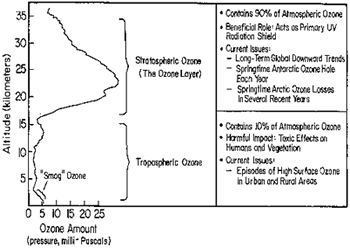
diagram depicting layers of atmospheric ozone


Science: Ozone Basics

Ozone is very rare in our atmosphere, averaging about three molecules of ozone for every 10 million air molecules. In spite of this small amount, ozone plays a vital role in the atmosphere. In the information below, we present "the basics" about this important component of the Earth's atmosphere.


Where is ozone found in the atmosphere?
Ozone is mainly found in two regions of the Earth's atmosphere. Most ozone (about 90%) resides in a layer that begins between 6 and 10 miles (10 and 17 kilometers) above the Earth's surface and extends up to about 30 miles (50 kilometers). This region of the atmosphere is called the stratosphere. The ozone in this region is commonly known as the ozone layer. The remaining ozone is in the lower region of the atmosphere, which is commonly called the troposphere. The figure (above) shows an example of how ozone is distributed in the atmosphere.

What roles does ozone play in the atmosphere and how are humans affected?
The ozone molecules in the upper atmosphere (stratosphere) and the lower atmosphere (troposphere) are chemically identical, because they all consist of three oxygen atoms and have the chemical formula O3. However, they have very different roles in the atmosphere and very different effects on humans and other living beings. Stratospheric ozone (sometimes referred to as "good ozone") plays a beneficial role by absorbing most of the biologically damaging ultraviolet sunlight (called UV-B), allowing only a small amount to reach the Earth's surface. The absorption of ultraviolet radiation by ozone creates a source of heat, which actually forms the stratosphere itself (a region in which the temperature rises as one goes to higher altitudes). Ozone thus plays a key role in the temperature structure of the Earth's atmosphere. Without the filtering action of the ozone layer, more of the Sun's UV-B radiation would penetrate the atmosphere and would reach the Earth's surface. Many experimental studies of plants and animals and clinical studies of humans have shown the harmful effects of excessive exposure to UV-B radiation.

At the Earth's surface, ozone comes into direct contact with life-forms and displays its destructive side (hence, it is often called "bad ozone"). Because ozone reacts strongly with other molecules, high levels of ozone are toxic to living systems. Several studies have documented the harmful effects of ozone on crop production, forest growth, and human health. The substantial negative effects of surface-level tropospheric ozone from this direct toxicity contrast with the benefits of the additional filtering of UV-B radiation that it provides.

What are the environmental issues associated with ozone?
The dual role of ozone leads to two separate environmental issues. There is concern about increases in ozone in the troposphere. Near-surface ozone is a key component of photochemical "smog," a familiar problem in the atmosphere of many cities around the world. Higher amounts of surface-level ozone are increasingly being observed in rural areas as well.

There is also widespread scientific and public interest and concern about losses of ozone in the stratosphere. Ground-based and satellite instruments have measured decreases in the amount of stratospheric ozone in our atmosphere. Over some parts of Antarctica, up to 60% of the total overhead amount of ozone (known as the column ozone) is depleted during Antarctic spring (September-November). This phenomenon is known as the Antarctic ozone hole. In the Arctic polar regions, similar processes occur that have also led to significant chemical depletion of the column ozone during late winter and spring in 7 out of the last 11 years. The ozone loss from January through late March has been typically 20-25%, and shorter-period losses have been higher, depending on the meteorological conditions encountered in the Arctic stratosphere. Smaller, but still significant, stratospheric decreases have been seen at other, more-populated regions of the Earth. Increases in surface UV-B radiation have been observed in association with local decreases in stratospheric ozone, from both ground-based and satellite-borne instruments.

What human activities affect upper-atmospheric ozone (the stratospheric ozone layer)?
The scientific evidence, accumulated over more than two decades of study by the international research community, has shown that human-produced chemicals are responsible for the observed depletions of the ozone layer. The ozone-depleting compounds contain various combinations of the chemical elements chlorine, fluorine, bromine, carbon, and hydrogen and are often described by the general term halocarbons. The compounds that contain only chlorine, fluorine, and carbon are called chlorofluorocarbons, usually abbreviated as CFCs. CFCs, carbon tetrachloride, and methyl chloroform are important human-produced ozone-depleting gases that have been used in many applications including refrigeration, air conditioning, foam blowing, cleaning of electronics components, and as solvents. Another important group of human-produced halocarbons is the halons, which contain carbon, bromine, fluorine, and (in some cases) chlorine and have been mainly used as fire extinguishants.

What actions have been taken to protect the ozone layer?
Through an international agreement known as the Montreal Protocol on Substances that Deplete the Ozone Layer, governments have decided to eventually discontinue production of CFCs, halons, carbon tetrachloride, and methyl chloroform (except for a few special uses), and industry has developed more "ozone-friendly" substitutes. All other things being equal, and with adherence to the international agreements, the ozone layer is expected to recover over the next 50 years or so.

10 Ways to Save the Earth

10 Ways to Save the Earth on Earth Day

10. Carpool or re-think you commute:

  • If you live close enough, ditch you car and walk or bike to work.
  • Car pollution alone kills about 30,000 people per year
  • Most ozone pollution is caused by motor vehicles
  • Wouldn't it be nicer to have the streets and freeways less congested?
  • Look into starting a carpool group in your area. Poll your office to see who's interested. Who knows, you may live on the same street as one of your coworker!

9. Make your own cleaning supplies

  • It's simple, really! If you didn't already see the episode of Decor It Yourself where Meg showed how to make all-natural cleaning products, watch it now!
  • It is reported that cleaning products are the cause of 8% of non vehicular emmisons of volitile organic compounds
  • The chemicals frequently reported in poison cases are found in cleaning products

8. Use energy efficient light bulbs

  • According to Energy Star, "If every American home replaced just one light bulb with an ENERGY STAR qualified bulb, we would save enough energy to light more than 3 million homes for a year, more than $600 million in annual energy costs, and prevent greenhouse gases equivalent to the emissions of more than 800,000 cars."
  • Enough said.

7. Use reusable shopping bags and lunch boxes

  • Consider this: the average American family accumulates about 60 plastic bags for only 4 visits to the supermarket.
  • If you watched the earlier Thread Heads episode, you'll know that tote bags are easy to make!
  • Tote bags are more stylish and fun to use, and some supermarkets will give you discounts or enter you in a raffle just for bringing your own bag!

6. Reduce your carbon footprint

  • What is a Carbon Footprint? It's a measure of the impact that our activities have on the environment in terms of the amount of greenhouse gases we produced. It's measured in units of carbon dioxide.
  • You can calculate your carbon footprint and once you know the harm that simple everyday things contribute to the environment, work to REDUCE YOUR CARBON FOOTPRINT!

5. Buy locally and support your local farmers market

  • When we choose not to buy locally, we pay for it. This means that the products have to be picked, packed and shipped from faraway places which contribute to pollution from car/truck emmisons. It also means that the produce have to be grown in a special way and given much more preservatives the survive the long haul they must travel to get to your grocery store.
  • If we support local farmers, not only does the produce contain more nutrients, but it also allows local farmers to keep their businesses alive and well. The produce is also more affordable than buying from mainstream markets.
  • Need help? Find your local farmers market here.

4. Use rechargeable batteries

  • Think about how many batteries you go through a month. From portable electronic devices, remote controls, clocks to stereos, some cell phones and toys, we are contributing to the toxicity of the Earth.
  • Batteries contain toxic elements such as cadmium, mercury, zinc and lead. Once these batteries and disposed and reach the landfill, the contents eventually released into the ground, soil, air and water.
  • Though rechargable batteries may be a little mor expensive, they last much longer and by using these, you can eliminate toxic waste that gets back into the air we breathe, water we use and the soil that we grow stuff in.
  • If you do have batteries that are non-rechargable, they should be recycled. Click here to find you local recycling center.

3. Conserve on the heater and air conditioning

  • In the winter time, use less heat to keep warm. Layer on the sweaters and bust of the extra thick comforters at night. (This is also better for your skin and overall health - heat is very drying)
  • In the summer, make sure you have thick curtains to keep the cold air in, turn off the lights when you're not using them.
  • Get an energy audit, so you can evaluate how much energy your home is using, how to reduce it and where the energy is leaking from.
  • Clean your filters on air conditioners monthly
  • Last year, Americans saved enough energy to power 10 million homes (this year, you can be one of those people that help!)

2. Don't use paper / plastic plates, utensils

  • By using disposable utensils and plates, we are contributing to the landfills with extra trash. Sure, it's way easier to throw away your dishes and utensils after a meal then to wash it, but let's face it, it's not only cheaper to use reusable dishware but it's also more eco-friendly.
  • What's the point of throwing away stuff when you're just going to have to buy it every week?
  • However, if you're at an outdoor gathering like a pic-nic and it just makes sense to buy disposable products, make sure they're biodegradable and eco friendly.
  • Bamboo is another great renewable resource for housewares, check out Totally Bamboo for great bamboo products that are good for the environment.

1. Reduce, Reuse, Recycle!

  • It may be the oldest saying in the book, but there's a reason why. If we recycle, reuse and reduce, we can help make our Earth a better, cleaner and longer lasting place for future generations.
  • Recycling a single plastic bottle can conserve enough energy to light a 60W lightbulb for up to 6 hours
  • Reduce – Reducing waste means avoiding unnecessary waste production
  • Reuse – Reusing waste means the multiple use of a product in its form
  • Recycle – Recycling waste means using waste materials to manufacture other products of a similar nature
Take the time and think about how you can make a differece. You may only be one person, but if everyone contributed a little, think of the difference all of us could make together! So when it comes to recycling and saving the Earth, do it for yourself,

What you do to save the ozone layer

When a health issue involves the health of the planet, people often feel there is little they can do to change the course of events. The depletion of the earth is protective ozone layer is one of these mega-issues. While most of the measures needed to safeguard the ozone layer involve nations and industries, there are significant steps you can take - as an individual consumer and as a member of a society.

There's good and bad ozone, depending on where it is, though both are chemically identical-a gas formed when three atoms of oxygen, rather than the normal two, bind together. The ozone found at ground level, a by-product of car and factory pollution, is one of the more dangerous components of smog. But in the earth's stratosphere, about 10 to 25 miles above us, ozone functions as a natural screen against the sun's most damaging ultraviolet (UV) rays. Unfortunately, the ozone that pollutes our air cannot reach the stratosphere's ozone layer.

What CFCs do

The stratospheric ozone layer is being destroyed in large part by man-made components called chlorofluorocarbons, or CFCs. These versatile chemicals, in liquid or gaseous form, have helped shape modern society. CFC s are used in coolants in our homes, cars and refrigerators; as foaming agents in foam insulation, mattresses, and food packaging; and as solvents that remove impurities from computer microchips and electronic equipment. The same properties that make CFCs efficient and safe for so many industrial uses also make them destructive for the environment. Their great stability ensures that when they are released into the air (during manufacturing, from leaky cooling systems, or upon disposal) CFCs eventually rise intact into the stratosphere, where radiation breaks them down into component atoms. One of these atoms, chlorine has a devastating effect on ozone. Other compounds called halons, used in some fire extinguishers, are even more destructive of ozone.

Scientists predict that by allowing more UV radiation to reach the earth, the depletion of the ozone layer will lead to an increase in the number of cases of skin cancer (especially melanoma) and cataracts. In addition, they postulate that the increased UV radiation may damage crops, kill plankton that serve as a food source for marine life, and even have adverse effects on the human immune system. CFCs may also trap heat in the atmosphere and thus contribute to the global warming trend (greenhouse effect).

For all these reasons, an international agreement in Montreal in 1987 called for phasing out CFC and halon production, and this past May in Helsinki these nations agree to rate the timetable. Recent reports by NASA that the ozone layer is being depleted even more rapidly that was previously projected, and the discovery of vast holes in the layer over Antarctica and the Arctic, have prompted scientists and environmental groups to call for a complete and rapid phase-out of CFCs. But even if we stopped using CFCs tomorrow, the damage to the ozone layer will continue, since those CFCs already released into the air will still be making their way to the stratosphere a decade from now and destroying the ozone for up to a century.

Substitutes have already been found for certain uses of CFCs. For instance, the EPA banned the use of CFCs as propellants in most, but not all aerosol sprays in 1978. CFCs can be modified so they do much less damage to the ozone layer, or so that they break down quickly in the lower atmosphere. Industries are also seeking ways to recycle the chemicals so that they aren't released into the air. Dupont, the world's largest manufacturer of CFCs, last year announced that it would phase out production by the end of the century.

Seven steps

The U.S. remains the biggest producer and consumer of CFCs. By following these steps, you can help reduce the American contribution to the destruction of the ozone layer.

* Have your car's air conditioner carefully serviced. Auto air conditioners are the single largest source of CFC emissions in the U.S. Don't simply refill your leaky air conditioner; if you don't have the leak fixed, the CFCs you leak will end up in the air. Go to a service station equipped to recycle the refrigerant (this costs an additional $35 to $55); otherwise, the CFCs will be vented into the atmosphere. In Los Angeles, an ordinance requiring service stations to recycle CFCs is expected to go into effect by January 1, 1990; it will also ban the sale of small cans of refrigerant, which allow people to 'top-off' their car air conditioners instead of repairing leaks. Car air conditioners using less harmful refrigerants are expected to be available in the mi-1990s. (Home air conditioners contain coolants that are far less ozone depleting.)

* Don't use foam plastic insulation in your home, unless it is made with ozone safe agents. Or use fiberglass,

gypsum, fiberboard, or cellulose insulation. * Don't buy a halon fire extinguisher for home use. * Check labels on aerosol cans. VCR-head cleaners, boat horns, spray confetti, photo negative cleaners, and drain plungers are still allowed to contain CFC's but such labeling isn't required.

* When buying a refrigerator, choose an energy efficient model: it may contain as little as half the CFC's. Thus when the fridge wears out and you dump it, less CFCs will be released. All refrigerators sold in the U.S. contain CFCs. To keep your fridge in the best working order, clean the coils regularly; that way it may last until CFC-free models are developed, or at least until recycling programs for CFCs are available. * If you feel strongly, write to your Senator and Representative and to President Bush, urging them to protect the ozone layer by tightening regulations on CFCs and halons, speeding up their elimination, mandating warning labels on products containing them, and pressing other nations to take such steps. Substitutes for CFCs may add to the cost of many products, be less efficient,, and have other drawbacks, at least at first. This may be hard to accept, especially since CFC emissions are invisible, and most of the damage they cause may not be evident for decade. But the steps we take now to protect the ozone layer will benefit our grandchildren.

Ten Ways To Save The World

It has been a really bad week for the climate. Each day brought depressing news as scientists meeting in Copenhagen told us global warming is taking place more rapidly than expected. The seas are rising faster than predicted; the polar ice caps are melting more quickly; and the Amazon rainforest is doomed unless urgent action is taken.

The main solutions are widely agreed. The world needs to forge a much tougher treaty this year to replace the failed Kyoto Protocol. Global emissions of carbon dioxide must be cut by at least half by the middle of the century, much more in industrialised countries. Using energy more efficiently is essential, as is rapidly increasing it from renewable sources. Nuclear power and biofuels are much more controversial, but are likely to be used to some extent. But new, much less familiar solutions are also emerging.

Here are 10 of them.

Sweep away soot

Cutting soot emissions from car exhausts, factories and open fires is probably the fastest way to tackle global warming, and there are calls for a treaty to achieve this. Scientists say the pollutant is the second biggest culprit in climate change after carbon dioxide. Black carbon, which gives soot its colour, has two main effects. It heats the atmosphere by absorbing radiation from the sun and releasing it into the air. And it darkens snow and ice when it falls on them, causing them to reflect less sunlight, heat up and melt – in turn exposing land or water, which also warms rapidly. Reducing emissions is fairly easy, using tried and tested technology. And it has a rapid effect as soot stays only days or weeks in the atmosphere, compared with centuries for carbon dioxide.

Save the ozone

Measures to save the ozone layer have so far been the most effective steps to combat climate change, as many of the chemicals that attack the protective layer in the atmosphere are also global warming gases. A 20-year-old treaty, the Montreal Protocol, has almost phased out their production, coincidentally eliminating the equivalent of 11 billion tons of carbon dioxide a year. This puts to shame the Kyoto Protocol, which aimed to cut emissions by 2 billion tons. Experts want measures to remove the chemicals from equipment such as old fridges, where they acted as coolants, when these are scrapped, saving the equivalent of 20 billion tons of carbon dioxide.

Make connections

Renewable energy is often unreliable: the sun does not always shine, the wind does not blow for ever. But the European Commission and other bodies are drawing up plans to get round this by tapping clean sources and linking them up, so that there will always be enough to meet all Europe's electricity needs. Solar power stations, for example, would be placed in the Sahara, where just a fraction of the desert could provide for the whole continent. Tides would be tapped along Britain's coasts, the world's best place for exploiting this resource. Huge wind farms would be erected in the North Sea, and these would be balanced by hydropower in mountainous areas such as Norway, storing water behind dams and releasing it on calm days. It would all be linked by a continent-wide electricity grid.

Wise up the grid

Barack Obama, David Cameron and Eric Schmidt, the chairman of Google, are all sold on creating a "smart grid", which the Tory leader describes as like moving from "the plain old telephone system to the internet". The present "dumb grid" just delivers electricity from generators to consumers; the smart one would enable them to communicate with each other. So, it can make fridges and washing machines and other appliances use power when it is abundant and cheap, and avoid peak times when it would be much more expensive. Smoothing out demand in this way means that the grid needs fewer power stations, and can accommodate renewable energy more easily. It would also provide a huge boost to a "rooftop revolution", where households generate their own electricity from the sun or the wind and sell what they do not need to the grid.

Rethink cars

Motoring could be revolutionised if cars were marketed like mobile phones – in a manner that would cut carbon dioxide and reduce the cost of driving. Motorists would get subsidised – or possibly even free – electric cars in the same way that customers currently get mobile phone handsets. In return, they would take out a contract for miles, rather than minutes, entitling them to get power either by plugging in to recharging points (at home, in car parks or on the street) or exchanging batteries at filling stations. The idea is the brainchild of a thirty-something former dot-com entrepreneur, Shia Agassi, who believes it would halve motoring costs. It sounds too good to be true, but Israel, Denmark, Hawaii and San Francisco are already starting to put the system in place – and even Gordon Brown has toyed with the idea. But to tackle climate change properly, the electricity has to be provided by renewable sources or nuclear power rather than fossil fuels.

Embrace scum

Slimy scum could prove our saviour, as algae are emerging as one of the most promising and environmentally friendly sources of biofuel. Algae can grow extraordinarily fast, doubling in weight several times a day. They produce at least 15 times as much fuel per hectare as conventional crops like corn or oilseed rape, and do not take up farmland needed to grow food; they can be grown in lakes, the sea or even in the process of cleaning polluted water. Algae take three times their own weight of carbon dioxide from the air while growing, and the fuel they produce packs much more power for its weight than other biofuels. It is therefore being developed as a potential carbon-neutral way of fuelling aircraft: Air New Zealand has already mixed it with ordinary jet fuel for test flights. Cars have run on pure algae biofuel, and big oil companies are investing in it.

Grow houses

Hemp is the world's second fastest growing plant after bamboo, shooting up four metres in just 14 weeks, rapidly taking carbon from the air. One hectare provides enough hemp to construct a house, if mixed with lime to revive an ancient building material. Limetechnology, the Abingdon-based firm pioneering the practice, calculates that growing it will capture 50 times as much carbon dioxide as would be saved by upgrading a traditional home to modern standards of energy efficiency. Biochar, an ancient technique used by Amazonian Indians to fertilise their land by burying charcoal, has even wider applications. Opponents worry that growing trees for it will take land out of food production, but Craig Sams – the co-founder of Green and Black's chocolate, who is now developing it – believes that just 21/2 per cent of the world's productive land would suffice to get carbon dioxide levels down to those of the pre-industrial age by 2050.

Pay for trees

Felling forests, especially in the tropics, is the second biggest cause of carbon dioxide emissions after burning fossil fuels, accounting for a fifth of the world's total. But people and governments have no incentive to leave them standing when they can make money by selling the timber, or farming the cleared land. Now international negotiators are beginning to work out how the world as a whole could compensate them for setting aside the chainsaw. In practice, of course, the money would end up coming from rich countries. Halving emissions from deforestation is estimated to cost about $20bn (£14.3bn) a year, but would avoid pollution costing at least five times as much. Similarly, Ecuador is seeking international compensation for refraining from developing a huge oil field lying under a particularly important area of Amazonian rainforest in the north-west of the country.

Reform taxation

Green taxes are beginning to come back into fashion after being eclipsed for years by sophisticated schemes for trading carbon emissions. They would work best as part of an "ecological tax reform", which would reduce taxes on employment – such as income tax and national insurance – at the same time. By shifting the burden from "goods", such as work, to "bads", such as pollution, it becomes cheaper to lay off barrels of oil than to fire people, reducing pollution and increasing employment. The European Union has estimated that this could create at least 2.7 million jobs across the continent, while combating global warming. The Conservatives and Liberal Democrats have both taken up the idea and promised to introduce it if they get into power. But so did Gordon Brown in opposition, and, despite introducing some modest measures in his 1999 Budget, he backed off after the fuel price protests the next year.

Follow a busker

A former busker, Aubrey Meyer, thought up what is increasingly regarded as the long-term solution to global warming – and, through relentless campaigning, he has managed to get his idea adopted as policy by many governments, especially in developing countries. Dubbed "contraction and convergence", it starts from the principle that everyone on Earth is entitled to emit the same amount of carbon dioxide. It then determines the level of emissions low enough to avoid dangerous climate change. The total amount put into the atmosphere worldwide each year must then be made to "contract" until it reaches this point. Simultaneously, the totals of individual countries have to "converge", so that each emits the same amount for every one of its citizens; rich countries would have to reduce their totals very heavily, while some poor countries could actually be able to increase theirs. Most experts agree that it is the fairest framework. Persuading Americans to agree to emit the same amount as Ethiopians is another matter.

Pollution Reduction Tips

Limit Chemical Use

1. Try using a plunger or boiling water to unclog drains before using a chemical drain opener.

2. Pull weeds by hand instead of using a chemical herbicide. Good topsoil will help your plants to grow and will decrease the number of weeds in your garden or yard.

Preventing Automobile Pollution

1. Carpool, use public transportation, walk or ride your bike to work instead of driving.

2. Run errands on your way to or from work or organize them so that you are not driving unnecessary miles.

3. Make sure your car is running well to avoid costly repairs, reduce pollution, and improve the mileage of your vehicle.

4. Stop filling your gas tank after the first “click” to reduce vapors. Do not “topoff” your tank.

5. If you are buying a car, consider buying the most fuel-efficient model. The new gas/electric Hybrid car can get more than 50 miles per gallon.

6. Clean out your trunk! You get 4% less gas mileage for every 100 pounds of extra cargo, and less gas mileage means your car releases more emissions that pollute the environment.

Shop Smart

1. Buy products with less packaging or packaging that can be reused or recycled.

2. Buy quality products that will last for a long time.

3. Buy only what you need, and use all of a product before purchasing more – especially when purchasing items that are toxic such as pesticides, some paints and cleaning products.

4. Look for the least toxic products to meet your needs. Many environmentally friendly alternative items, such as household cleaners and degreasers, can be found on the shelves of most grocery and hardware stores.

5. Reuse shopping bags or ask that your purchases be put into as few bags as possible.

6. Borrow or rent items you do not use often instead of buying them.

Other Pollution Reduction Tips

. Talk to your kids about what they can do to improve air quality.

2. Restrict the use of gasoline-powered equipment. Leave lawn mowing for another day.

3. Use electric-powered or manual tools, which don't produce any pollution.

4. Delay using oil-based paints, solvents and cleaners.


Pollution Reduction Tips

Travel Tips:

  • Leave your car at home, walk, cycle, carpool or take public transit. Conference by phone instead of driving to meetings.
  • Limit car trips by doing all your errands at once.
  • Turn off the car's air conditioner. It reduces gas mileage by as much as 20 per cent.
  • Avoid driving during peak traffic periods when stop-and-go traffic is at its worst, and listen to traffic reports to avoid congestion.
  • Do not let your engine idle. Shut off your car while waiting for long freight trains to pass.
  • Drive at moderate speeds.
  • Keep your car well tuned and check your tire pressure regularly for good fuel efficiency.
  • Use high octane unleaded gas in your vehicle. Premium quality gasoline produces less sulphur than the regular brands.
  • Refuel your vehicle after dusk when the sun is no longer turning air pollutants from car exhaust and spilling fuel into smog. Do not overfill the tank and be careful not to spill fuel.
  • Travel light. Take unnecessary items out of the trunk.


Health Tips:

  • Wear light clothing at work while air conditioning is reduced.
  • Avoid strenuous exercise in the heat of the day.
  • Reduce your exposure to exhaust fumes by staying away from heavy traffic area when walking or cycling.
  • On smog alert days, children, the elderly and people with chronic heart and lung ailments should remain indoors during the late afternoon and early evening.


Electricity Saving Tips:

  • Conserve electricity by setting air conditioners no lower than 25°C (77°F). Fans use much less energy than air conditioners.
  • Turn off lights you are not using.


Other Pollution Reduction Tips:

  • Talk to your kids about what they can do to improve air quality.
  • Restrict the use of gasoline-powered equipment. Leave lawn mowing for another day.
  • Use electric-powered or manual tools, which don't produce any pollution.
  • Delay using oil-based paints, solvents and cleaners.

It's A Global Issue

Climate Warming Is a Global Problem

But the impacts and potential solutions will affect us locally and in many different ways. The challenge for each of us and for our policy makers is to pursue effective responses that are as fair as possible to all people and nations.

In this exhibition the National Academies provide scientific information to help us make informed decisions and to help answer some important questions.

Is The Climate Warming?
Are Humans Causing Climate Warming?
What Effects Might Climate Warming Have?
What Should Be Done About Climate Warming?

The general retreat of mountain glaciers during the past century is one example of evidence that the climate is changing.

Photos of South Cascade Glacier, Washington in 1928, 1979, and 2003

1928
South Cascade Glacier, Washington
1979
South Cascade Glacier, Washington
2003
South Cascade Glacier, Washington

A growing body of evidence indicates that humans now have a significant impact on climate. Nevertheless, it is difficult to identify humans as the only cause of a particular weather event or local climate change.

Earth Saving Tips from Earth Share Air Pollution

Water is Essential for Life


It covers 71% of the earth's surface and makes up 65 % of our bodies. Everyone wants clean water-- to drink, for recreation, and just to enjoy looking at. If water becomes polluted, its loses its value to us economically and aesthetically, and can become a threat to our health and to the survival of the fish living in it and the wildlife that depends on it.

How does water pollution occur?


Although some kinds of water pollution can occur through natural processes, it is mostly a result of human activities. We use water daily in our homes and industries, about 150 gallons per day per person in the United States. The water we use is taken from lakes and rivers, and from underground (groundwater); and after we have used it-- and contaminated it-- most of it returns to these locations.

The used water of a community is called wastewater, or sewage. If it is not treated before being discharged into waterways, serious pollution is the result. Historically, it has taken humanity quite a bit of time to come to grips with this problem. Water pollution also occurs when rain water runoff from urban and industrial areas and from agricultural land and mining operations makes its way back to receiving waters (river, lake or ocean) and into the ground.

What are some different types of water pollution?


Microbiological
Disease-causing (pathogenic) microorganisms, like bacteria, viruses and protozoa can cause swimmers to get sick. Fish and shellfish can become contaminated and people who eat them can become ill. Some serious diseases like polio and cholera are waterborne.
Chemical
A whole variety of chemicals from industry, such as metals and solvents, and even chemicals which are formed from the breakdown of natural wastes (ammonia, for instance) are poisonous to fish and other aquatic life. Pesticides used in agriculture and around the home-- insecticides for controlling insects and herbicides for controlling weeds-- are another type of toxic chemical. Some of these can accumulate in fish and shellfish and poison people, animals, and birds that eat them. Materials like detergents and oils float and spoil the appearance of a water body, as well as being toxic; and many chemical pollutants have unpleasant odors. The Niagara River, between the US and Canada, even caught fire at one time because of flammable chemical wastes discharged into the water.
Oxygen-depleting Substances
Many wastes are biodegradable, that is, they can be broken down and used as food by microorganisms like bacteria. We tend to think of biodegradable wastes as being preferable to non-biodegradable ones, because they will be broken down and not remain in the environment for very long times. Too much biodegradable material, though, can cause the serious problem of oxygen depletion in receiving waters.
Like fish, aerobic bacteria that live in water use oxygen gas which is dissolved in the water when they consume their "food". (The oxygen in the compound H2O, water, is chemically bound, and is not available for respiration (breathing)). But, oxygen is not very soluble in water. Even when the water is saturated with dissolved oxygen, it contains only about 1/25 the concentration that is present in air. So if there is too much "food" in the water, the bacteria that are consuming it can easily use up all of the dissolved oxygen, leaving none for the fish, which will die of suffocation.
Once the oxygen is gone (depleted), other bacteria that do not need dissolved oxygen take over. But while aerobic microorganisms-- those which use dissolved oxygen-- convert the nitrogen, sulfur, and carbon compounds that are present in the wastewater into odorless-- and relatively harmless-- oxygenated forms like nitrates, sulfates and carbonates, these anaerobic microorganisms produce toxic and smelly ammonia, amines, and sulfides, and flammable methane (swamp gas). Add in the dead fish, and you see why we don't want large amounts of biodegradable materials entering lakes and streams.
Nutrients
The elements phosphorus and nitrogen are necessary for plant growth, and are plentiful in untreated wastwater. Added to lakes and streams, they cause nuisance growth of aquatic weeds, as well as "blooms" of algae, which are microscopic plants. This can cause several problems. Weeds can make a lake unsuitable for swimming and boating. Algae and weeds die and become biodegrable material, which can cause the problems mentioned above (and below). If the water is used as a drinking water source, algae can clog filters and impart unpleasant tastes and odors to the finished water.
Suspended matter
Some pollutants are dissolved in wastewater, meaning that the individual molecules or ions (electrically charged atoms or molecules) of the substance are mixed directly in between the molecules of water. Other pollutants, referred to as particulate matter, consist of much larger-- but still very small-- particles which are just suspended in the water. Although they may be kept in suspension by turbulence, once in the receiving water, they will eventually settle out and form silt or mud at the bottom. These sediments can decrease the depth of the body of water. If there is a lot of biodegradable organic material in the sediment, it will become anaerobic and contribute to problems mentioned above. Toxic materials can also accumulate in the sediment and affect the organisms which live there and can build up in fish that feed on them, and so be passed up the food chain, causing problems all along the way . Also, some of the particulate matter may be grease-- or be coated with grease, which is lighter than water, and float to the top, creating an aesthetic nuisance.

How do we prevent water pollution?


To keep our used water from spoiling our water resources, we have to remove the pollutants before the water gets back into the environment. In urban areas in most developed countries, the wastewater from homes, businesses and factories is collected by a system of underground pipes-- sewers-- which carry it to one or more central treatment facilites. Most of these are located near bodies of water into which the treated wastewater is discharged.

In the U.S., all such facilites must have a permit issued by the federal and/or state government, describing limits on the amounts of various pollutants which may be discharged. The U.S. EPA (Environmental Protection Agency) refers to these as NPDES (National Pollutant Discharge Elimination System) permits. Industries located in areas where they are not connected to a sewer can discharge directly into a waterway, but will need a permit, and will probably have to have their own treatment plants. Even industries which are connected to sewers may have to pretreat their wastewaters before discharging them into the sewers, because they may contain materials which will harm the sewers or the treatment plants-- or may be a danger to the people who work in maintaining the sewer system.
[If you are some one who works in an industrial pretreatment program, you may be aware that the USEPA has recently (July 22, 1999) proposed a series of changes to the current regulations. I have prepared a summary of the proposals which you may find helpful before reading the entire document.]

Homes in non-urban areas that are not connected to a sewer are usually required by their town to have on-site treatment systems. Most common for single homes are septic systems, which consist of a buried tank connected to a set of perforated pipes, embedded in gravel, which distribute the water into the soil. (The "Links" page has several references on this subject.) Larger housing complexes may have treatment systems based on the principles used in full-scale sewage treatment plants.

A Word About Sewers: Besides having a set of sewer pipes-- called, strangely enough, sanitary sewers-- which carry wastewater to a treatment plant, cities and towns also need pipes to collect stormwater. These are needed to prevent street flooding and usually lead directly to a waterway without any treatment. The runoff of pollutants from streets and yards into these storm sewers contain oil and other automotive wastes, which may contain toxic metals and organic compounds-- as well as pesticides and nutrient-containing fertilizers from lawns and gardens, and pathogenic microorganisms from animal wastes. The problem of pollution from storm sewers is currently being addressed by the USEPA. Further complicating the situation is the fact that while some cities and towns have completely separate sanitary and storm sewer systems, many others have combined systems. During rainy periods, combined sewers cause two problems: overloading of the treatment plant with extra water and contaminating waterways with untreated sewage from overflows. Even in cities with separate sewer systems, the flows to the treatment plants often increase greatly when it rains because of cracks or separations in the pipes, which allow groundwater or stormwater from broken storm sewer pipes to infiltrate into the sanitary sewer-- or from direct inflow of stormwater into manholes and from illegal connections of roof drains and sump pumps in buildings

Global Warming: An Environmental Issue, a Human Issue

The woman gathering fuelwood in the Sudan senses a difference. She has survived two extremely dry years and then, in only three days, sees a year's rain fall. The American, Australian, and African farmers who have seen deep droughts and big rains crush their crops again and again in the last 10 years, can feel a difference in the soil and smell a difference in the air. The Bangladeshi boatman, who sees the "once-in-a-century" typhoon surge out of the Bay of Bengal twice in twenty years senses that the weather has changed since his childhood. The South Pacific ecologist of coral reefs knows that something significant has disturbed the seabed; she sees large masses of dying coral. The Swiss ski resort owners, who wait through two long winters without sufficient snow on which to ski, all know something is different. But what is it? A string of random independent events? A passing phase? Or are the collective experiences of people all over the world an indicator of a profound and lasting change, a global climate change?

-taken from Confronting Climate Change: Risks, Implications, and Responses

Change is in the air. The warmest years on record have all occurred since 1990. Extreme climactic events are increasing in intensity and frequency. Glaciers are melting. Sea levels are rising. While we have yet to see plagues of frogs and locusts, it is clear to scientists, researchers, and policymakers that the earth is going through major climatic change. While this concept is not a new phenomenon--- climate on Earth has experienced natural variation many times in the last two billion years--- something is different this time. The composition of our atmosphere is changing at an unprecedented rate, and many researchers claim that human activities such as deforestation and the emission of "greenhouse gases" such as carbon dioxide and chloroflourocarbons (CFCs) into the atmosphere are to blame for these present and inevitably for the future changes in our climate. Skeptics argue that these activities enhance the greenhouse effect, a natural process that keeps the temperature of Earth warm and hospitable to humans, so as to cause an additional, human-induced, greenhouse (or 'global') warming. The reliability of the climate models that communicate this climate change has also been questioned by these skeptics. While the enhanced greenhouse effect cannot be definitively tied to greenhouse gas emissions just yet, the circumstantial evidence is overwhelming, and risk of further danger is severe. The causes and impacts of global climate change, human-induced or not, touch every aspect of human society, making the issue of global warming not merely a scientific, political, or economic concern, but a human issue requiring immediate action.

THE EFFECTS OF GLOBAL WARMING

"Global warming will be the greatest environmental challenge in the 21st century."
- Vice President, Albert Gore.

One of the most current and widely discussed factor which could lead to the ultimate end of existence of Earth and man is global warming and its devastating effects. Scientists have asked how fast the Earth is heating up, and how the warming effects on Earth may effect crops and climatic conditions. Several current trends clearly demonstrate that global warming is directly impacting on; rising sea levels, the melting of icecaps, and significant worldwide climatic changes. This paper will discuss the degree of destruction caused by global warming, contributing factors to warming, and finally, discuss what we can do to decrease the current rate of global warming. I would also like to present opposing viewpoints to the effects of the warming process. In my understanding, global warming represents a fundamental threat to all living things on earth.

WHAT IS THE "GREENHOUSE EFFECT" ALL ABOUT?

It is important to understand and discuss the significance of global warming. Global warming is also known as the "Greenhouse effect". The "Greenhouse Earth" is surrounded by a shield of atmospheric gases, rather than a glass or a plastic cover. The air that makes up our atmosphere consists primarily of nitrogen and oxygen molecules (N2 at 78% and O2 at 21%). A large number of "trace gases" make up the remainder of air's composition. Many of these, including carbon dioxide (CO2) and methane (CH4) are the so called "greenhouse" gases. If you have ever felt the piercing cold of the clear winter night sky and wondered why you feel warmer on a cloudy winter night, you have experienced the atmospheric greenhouse effect firsthand. Physics tell us that any object warmer than absolute zero will radiate energy. Cooler objects emit longer waves (in the infrared region) while hotter ones radiate shorter wavelengths. Our sun, powered by its hot, nuclear fusion reaction, produces radiant energy in the visible and ultraviolet regions with relatively short wavelengths. Of the sunlight that strikes the earth, about 70% is absorbed by the planet and its atmosphere, while the other 30% is immediately reflected. If the earth did not re-radiate most of this newly absorbed energy back into space the world would continue to get warmer. Instead, an energy balance is maintained.

The earth is about 60 degrees Fahrenheit (33 degrees Celsius) warmer than it would be if it did not have the atmospheric blanket of greenhouse gases and clouds around it. Clouds and greenhouse gases keep the earth warm. Once warmed, their molecules then radiate a portion of this heat energy back to earth, creating more warming on the surface of our planet. It is this radiation which causes atmospheric gases to move back to earth that scientists call the "greenhouse effect".

Carbon dioxide (CO2) gas generated by man's burning of fossil fuels and the forests is responsible for about half the greenhouse gas warming. Other gases (CFCs, methane, nitrous oxide, tropospheric ozone) are responsible for the rest. Increases in all these gases are due to mankind's explosive population growth over the last century, and increased industrial expansion. Approximately 80% of atmospheric CO2 increases are due to man's use of fossil fuels: oil, coal, and gas. These petroleum-based energy sources first came into use with the burning of coal during Since 1945 petroleum consumption has increased dramatically, due in large part to increased usage of automobiles worldwide, and the substitution of mechanized farm machinery for animal power. "Mankind is in the process of conducting a major, unintentional experiment, that of feeding back into the atmosphere in a short space of geological time the fossils fuels that have slowly accumulated over the past 500 million years." (Refer to graph #1)

Graph 1
Excluded

In 1958, scientists began to measure carbon dioxide levels in the atmosphere. The site selected for these measurements was on top of the volcanic mountain of Mauna Loa, in Hawaii. CO2 measurements at the Hawaiian site have continued. The instruments show the level of CO2 has been steadily increasing (about 0.4% per year) from a level of 315 parts per million (ppm) in 1958 to 353 ppm in 1990. Clearly, Earth's natural mechanisms for absorbing CO2 from the atmosphere cannot handle the large quantities of CO2 being added by modern man. Scientists believe nearly 1/2 of the CO2 being emitted each year remains in the atmosphere, while the rest is being absorbed by trees and the oceans. As a result, CO2 measurements show a continuing build-up of CO2 greenhouse gases in the air, gases that will eventually lead to more global warming. (Refer to graph #2)

Graph 2

HOW FAST IS THE EARTH HEATING UP?

Much debate in the last five years about the greenhouse effect has centered on interpreting temperature numbers generated at weather stations all over the world. The data from these thermometers are averaged and plotted in attempts to determine just how fast the earth has heated up since the measurements began. There is now no doubt the world is getting warmer. The thermometers show that the world is warmer now than at any time since the measurements started. The year 1990 was the hottest year in the last century. Together with 1991, the years of 1983, 1987, 1988, and 1989, have been measured to be the warmest 6 years in the last hundred years. 1991 was the second warmest year of the past century, perhaps due to the eruption of Mt. Pinatubo during that year. The ash from the volcano in the upper atmosphere blocks some sunlight to earth, and is expected to generate a temporary two or three year cooling effect. After that time, most ash particles will have settled back to earth, and most scientists expect to see the global warming trend continue.

According to scientists, we can with "99% confidence conclude that current temperatures represent a real warming trend rather than a chance fluctuation over the 30-year period." Most scientists agree that the planet's temperature has risen 0.5 degrees Celsius since 1900, and will continue to increase at an increasing rate. The environment is responding to this warming. For instance, a study of mountain plants in the Alps (Europe), shows that some cold-loving plants are starting to move to higher and cooler altitudes. That is a possible response to increasing temperatures.

CURRENT TRENDS.

The global effects of the greenhouse effect cannot be directly predicted simply because we do not have enough knowledge in the subject. However, we have been able to draw direct connections between certain natural phenomenon that supports the idea that something is changing.

Global warming has great effect on crops and weather conditions around the world. The northern hemisphere contains more land area than the southern hemisphere, and conversely, a lower percentage of the world's oceans. Since oceans absorb more heat than land areas, it is not surprising that most climate models predict faster heating over the northern hemisphere than the global average. In addition, models predict faster temperature increases at higher latitudes. If global warming trends continue, high temperatures everywhere in the US may reduce US agricultural productivity. Northern continental areas are projected to have drier summer soils, due in part to earlier snow melts in the spring, and hotter, more cloudless summers, causing extensive evaporation of ground moisture. In addition, if the inland areas of the northern hemisphere are expected to receive less moisture, then, lake and river levels will be lower. Some reports predict the level of the Great Lakes will drop between 2 and 8 feet. River flows in the western US may be very vulnerable to increase temperatures expected as result of the greenhouse effect.

When many people think of global warming, their first concern is the possible rise of sea levels. With a large number of the world's cities in coastal areas, this is a significant problem. There are two major causes of rising sea levels. First, extra water is produced when ice melts. Secondly, the natural expansion of sea water as it becomes warmer. The range of sea ice around both poles continues to shrink, as it melts. Even with the level of greenhouse gases present today, the earth may warm enough in the next 50 years or so to completely melt the sea ice located on the poles.

Damage from rising seas is very diverse. Buildings and roads close to the water could be flooded and they could suffer damage from hurricanes and tropical storms. "There are good physical reasons to suggest that more intense storms (hurricanes) could result from global warming." Warmer oceans cause more intense storms. Experts believe that global warming could increase the intensity of hurricanes by over 50 percent. Hurricane Andrew's devastation in 1992 set new records. According to the National Hurricane Center in Miami, the 1990 season was the most active year on their records for combined Atlantic and Pacific hurricanes. Damage caused by future hurricanes to populated areas will be more severe since higher sea levels are predicted for the next century. In addition, as the sea rises, beach erosion takes place, particularly on steep banks. Wetlands are lost as sea levels rise. Another serious problem is the threat of salt water intruding into underground fresh water reserves in coastal areas.

In 1992, a report was published by the United Nations, which proposes that if CO2 and other greenhouse gas emissions continue with present trends (which is the case), the coastal plains of Bangladesh and the Netherlands will flood by the year 2100. Furthermore, the islands of the Maldives would completely disappear. This would happen if only a two foot increase in sea level occured.

FOREST DESTRUCTION CREATES MORE HEAT:

Trees play a unique role in the global carbon cycle. They are the largest land-based natural mechanism for removing CO2 from the air. (CO2 is also removed by the oceans and ocean organisms.)

Trees are able to store a large amount of CO2 in their structures. An acre of forest will absorb about 10 times the CO2 amount absorbed by an acre of crop land or grassland. One tree absorbs about 13 pounds of CO2 per year, and each one acre of forest absorbs about 2.8 tons of CO2. However, when trees are burned, the carbon locked in the structure is released into the air in the form of CO2. Today, the shrinking world forests are not able to absorb all the CO2 created by human beings while burning fossil fuels. Everyday over 5500 acres of rain forest are destroyed, and over 50 million acres are destroyed every year. Global CO2 levels rise approximately 0.4 percent each year, to levels not experienced on this planet for millions of years. Planting more trees and reducing timber cuts world-wide will help restore the imbalance, and perhaps buy time as ways are found to reduce world greenhouse gas emissions.

POPULATION GROWTH CONTRIBUTES TO GLOBAL WARMING.

The intellectual powers that we enjoy has enabled us to make effective use of technology and thereby changed the environment. Technology is partly responsible for explosive population growth and responsible for the resulting damage to Earth's resources. The industrial revolution caused a rapid increase in the Population growth, as oil and gas fuels were exploited for our use. There is a clear link between the problems of global warming and overpopulation, as increases in CO2 levels follows growth in population. Presently, we have too many people on Earth, who are using technologies that are destructive for the Earth. We cannot continue to grow, and make use of limited natural resources. (Refer to graph #3)

Graph 3

ECONOMIC ASPECTS:

Global warming is big business. Some economists argue that a warmer climate could benefit certain crops and the farming communities. However, property insurers are predicting that worsening storms caused by global warming could eventually bankrupt the insurance industry. Insurance companies are now trying to form strategic alliances, and pool resources which could cover severe economic loss from climatic changes.

In addition, the costs to implement a worldwide plan to cut the production of CO2 and other gases which contribute to global warming would cost approximately 3 percent of the World's total GDP. However, there is a dispute whether the industrialized world should be responsible for the main economic contributions to clean up this planet. It is important to realize that many less industrialized nations are unable to afford actions to prevent an increase in CO2, and the fact that they have no incentive to reduce the carbon emissions that cause the "greenhouse" effect. Several less industrialized nations argue that the developed world was allowed to use of the nature in creating welfare, and that it is now morally right for them to do the same. I believe that funds dedicated to the former Cold war should be used for world ecology.

OPPOSING VIEW POINTS IS GLOBAL WARMING A THREAT?

Certain scientists believe that global warming is not a threat and the planet is essentially cooling off. They argue that the factors causing the phenomenon and the measurements are not fully understood, and that it is impossible to draw any conclusions whether the warming of the earth is a purely natural occurrence. These people, believe that the trend is a false alarm and that it is not a sign of a fore coming global disaster. In addition, Industrial forces argue that human beings can adapt to the changes caused by global warming, but they refuse to mention anything about the environmental impact of climatic changes.

Other opponents to the Global warming theory believes that most changes are due to the energy of the sun is fluctuating. Large sunspot activity is thought to be partially responsible for the "Little Ice Age" from 1450 to 1850. This climate change is well documented in history with many impacts on civilization in Europe, including famines. The temperature fluctuation was only about 2 degrees Fahrenheit. Also, some researchers believe that smoke from the burning of tropical forests and grasslands causes a strong cooling force on the climate. This cooling effect could nearly equal the warming power built by greenhouse gases created by the fires.

Furthermore, in the issue regarding rising sea levels, It is important to realize that the elevations of various coastal land areas are rising and sinking due to geological factors. Thus, the ocean levels may not rise as much as we think, as continents may be sinking.

In addition, some researchers believe that global warming is foreshadowing a coming ice-age. The last ice age occurred as the Earth's climate was warming. In the Arctic regions, more water would evaporate in summer, and fall onto the land as snow in winter. The winters would not be so warm as to melt all of this snow, thus glaciers would grow. Also, some carbon compounds released in the atmosphere may help prevent global warming. These particles reflects sunshine, which is redirected into space.

WHATYOU CAN DO TO DECREASE GLOBAL WARMING.

There are several things which you can do directly after reading this paper. However, some of the actions which we all have to take will slightly decrease your present standards of living.

First, since the largest portion of electricity in the US is produced by burning coal, we should try to cut-down on our demand for electricity. (Refer to graph #4) Coal combustion creates the largest amount of CO2 per energy unit of any fossil fuel. Coal and oil together represent 80% of the US fuel supply used to generate electricity. When we reduce electric power use, we save money, breathe cleaner air, and help to reduce the global warming problem. Every kilowatt-hour of electricity saved keeps 1.5 to 2 pounds of CO2 out of the atmosphere. Americans waste more energy than any other nation. I believe it is time to make our lives, factories, and homes more efficient. Look around at home, and at your work place, and you will find several ways in which you can decrease the use of electricity. For instance, plant several trees on the south side of your house where they can give shade during the hot summer months. Also, install an energy efficient thermostat, with a day and night timer.

Graph 4

Second, decrease the use of your car. If you can't afford to buy a new fuel-efficient car in the next few years, consider selling or junking your gas demanding car and buying a smaller, efficient used car. Besides saving money on gas, oil, tires, parts, and repairs, you can help reduce greenhouse gases. Furthermore, no matter what type of car you drive, be sure to operate it efficiently, try to carpool to work or ride the bus, keep the car tuned up, walk or ride your bike for short distances, park and walk do not use "drive thru" services.

Third, try to follow the following environmental policy of "Reduce....Reuse.....Recycle." Reuse of anything is the easiest and best way to recycle. Save containers, bags, everything that you may be able to use in the future. Also, use cloth towels and napkins instead of paper ones, and use rechargeable batteries instead of disposable ones.

Furthermore, you can reduce the need to recycle paper by getting off the junk mail lists. Why should trees be destroyed for mail you do not even want to receive? In addition, always remember that recycling is only effective when you buy products made from recycled materials. Otherwise, what is the point of recycling?

Also, remember that each time you make a purchase, you either reinforce a bad environmental product, or you encourage a good one. I believe that people should try to buy quality products that can be used for a long time, buy products with minimal packaging, and not buy disposable products. We certainly have to make-up our minds whether our success as an individual should not be based on the quantity of our consumption, or on the quality of our natural environment.

I believe that It is time to examine our moral values. Examine our attitudes as they relate to our natural world. Each of us needs to ask ourselves: What makes us really happy? What makes us feel secure? It is highly questionable if money and tangible objects make us more happy, it is even possible that we tend to be less happy with our life's when we have a lot of tangible objects and money to care for. Has our striving for more and more materialistic consumption caused us to forget that we are living human beings? We have to realize that we have much more in common with the plants, animals, air and water than we have with the mechanical, chemical and electronic world we have created around us.

Unfortunately, the disbalance which we have created between our life's and the Earth is already showing the signs of disaster. "Earth in the Balance" is moving to the Earth in imbalance, which, in the long run will cease to exist. Remember, we are all in the greenhouse together, nobody can stop the world and get off